Short answer: to sell agricultural land in Tamil Nadu, first make sure the patta is in your name and matches your sale deed, then collect a 30-year encumbrance certificate (EC) and the FMB sketch, and check the guideline value on TNREGINET. Price the land, find a buyer, sign a sale agreement, and register the sale deed at the sub-registrar office. In many cases the patta moves to the buyer automatically after registration. The paperwork is usually the slowest part, so start there.
This guide covers each step for owners, with the documents buyers ask for, the problems that hold sales up, and the tax you may owe.
Documents you need to sell
| Document | Why the buyer asks for it | Where to get it |
|---|---|---|
| Your sale deed and the earlier deeds (parent documents) for 30 years | Proves how the land came to you | Your records; certified copies from the sub-registrar office |
| Patta (with the chitta details) | Shows the land is in your name in the revenue records | eservices.tn.gov.in |
| FMB sketch | The survey map with the field's shape and measurements | eservices.tn.gov.in |
| Encumbrance certificate (EC) for 30 years | Shows no loan, earlier sale or attachment is registered against the land | tnreginet.gov.in |
| Adangal (A-register extract) | How the village records class and use the land | The village administrative officer (VAO) or e-services |
| Legal heir certificate or partition deed | If you inherited the land, it shows your share and who else must sign | The taluk office, or your registered partition deed |
| Loan closure letter and release deed | If the land was ever mortgaged, it shows the loan is cleared | Your bank and the sub-registrar office |
| Aadhaar and PAN | Needed at registration; PAN is required for property worth ₹10 lakh or more | Your own |
Fix these before you look for a buyer
Most stalled land sales in Tamil Nadu come down to one of these. Sorting them out first saves weeks later and keeps buyers from walking away.
- The patta is still in a parent's name. Get it transferred to you first, using the legal heir certificate. Our guide to patta transfer in Tamil Nadu explains how.
- The patta is joint, or you are selling part of a survey number. The land will need a subdivision, which means a surveyor's visit. Start it early.
- Names or extents do not match. If your name, the survey number or the area differs between the deed, the patta and the FMB sketch, get it corrected at the taluk office.
- The EC shows an old loan. Get a release deed registered once the loan is closed.
- Every owner must agree. All co-owners and legal heirs need to sign the sale deed, or release their share to you first.
- Check the land's class. Government land (poramboke) and assigned land, such as Panchami land, usually cannot be sold. Check this before you promise a buyer anything.
How to price your land
- Guideline value: the government's value for your survey number, used to work out stamp duty. Look it up on TNREGINET by village and survey number. Stamp duty is charged on the guideline value or the sale price, whichever is higher.
- Market value: what buyers actually pay nearby. Our agricultural land value calculator gives a price per acre for every district in Tamil Nadu, and recent sales in your village tell you even more.
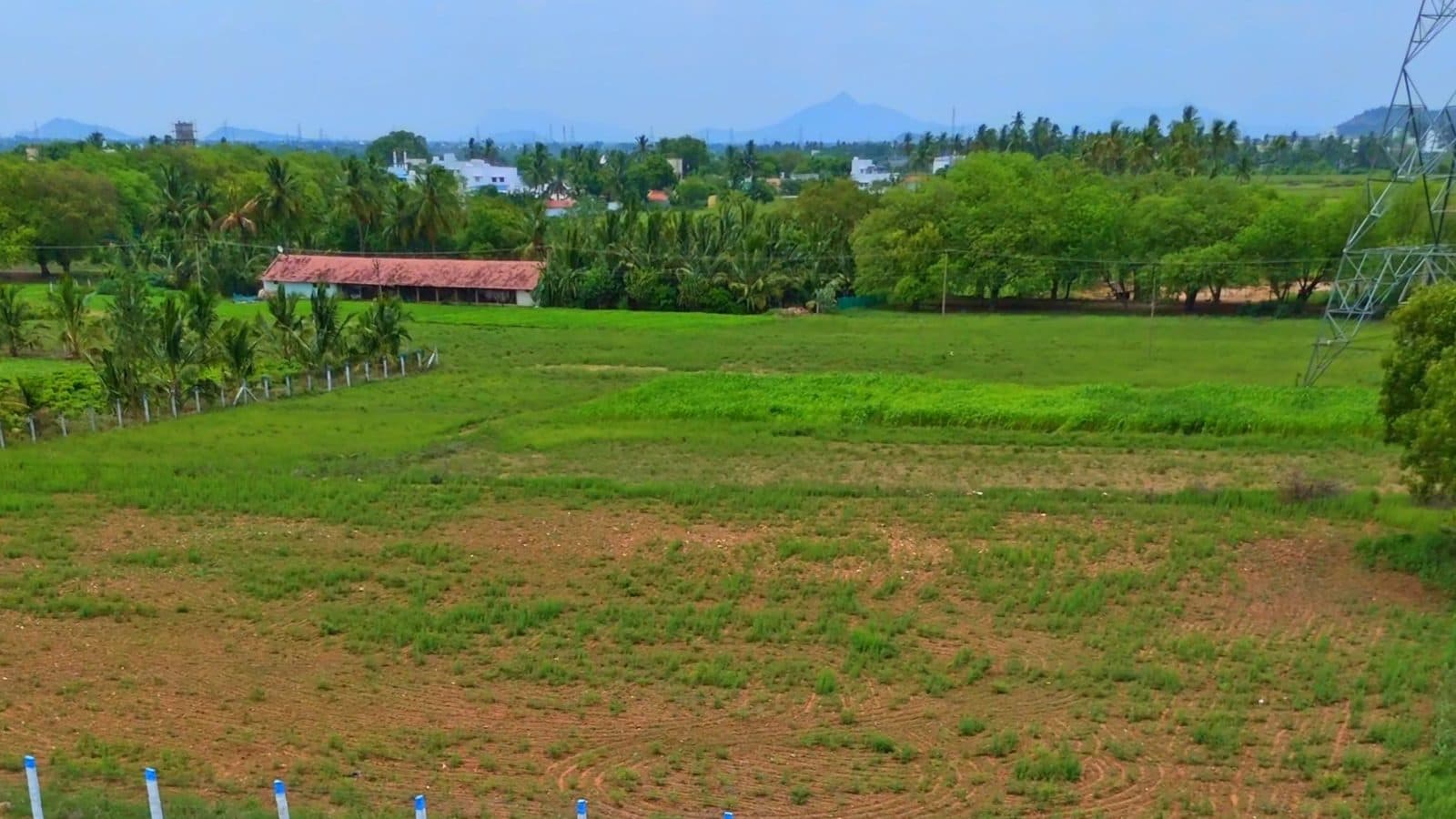
- What adds value: a road along the boundary, reliable water (a working borewell, an open well or canal rights), an electricity connection, clear documents, a regular shape and a short drive to a town or highway.
Finding a buyer
- Show the land properly. Most buyers decide whether to visit from what they see online. A clear video of the boundaries, the road and the water source does more than a few photos.
- Reach buyers beyond your village. Many buyers of farm land live in nearby cities, or abroad and buy through family in India.
- Check that buyers are serious. Ask how they will pay and when. Banks lend for farm land mainly to farmers, so most buyers pay from their own funds.
- Brokers can help but usually charge a commission. See what selling without a broker costs.
The sale agreement and advance
Once you agree a price, sign a written sale agreement before you take an advance. It should state the price, the advance, the date for the balance and registration, who pays the registration costs, the documents you will hand over, and what happens if either side backs out. Take the advance by bank transfer, not cash, and ask a lawyer whether to register the agreement.
Registering the sale
- Prepare the deed and book a slot online on TNREGINET. The stamp duty and registration fee are paid online.
- Know who pays. The buyer usually pays the stamp duty and registration fee. For a sale deed in Tamil Nadu that is 7% stamp duty plus a 2% registration fee, on the guideline value or the sale price, whichever is higher. Check the current rates on TNREGINET.
- Attend the sub-registrar office. All sellers, the buyer and two witnesses go in person with ID, PAN and the original documents. Photos and fingerprints are taken there.
- Collect the balance safely. Take the full balance by bank transfer or demand draft, and confirm it has reached your account before you sign. Never hand over original documents before you are fully paid.
After registration: the patta
Since 2021, Tamil Nadu has updated the patta automatically at registration when the whole survey number or subdivision is sold, the seller has an individual patta and the area does not change. In other cases the buyer applies for a patta transfer. Either way, check online a few days later that the patta shows the buyer's name, so nothing comes back to you later.
Tax on the sale
Income tax law treats rural agricultural land differently from other property. Agricultural land is rural if it is not inside a municipality or cantonment board with 10,000 or more people, and is more than a set distance from one (2 km for towns of 10,000 to 1 lakh people, 6 km up to 10 lakh, and 8 km for larger towns). Rural agricultural land is not a capital asset, so selling it carries no capital gains tax and no TDS. Agricultural land inside or close to towns is a capital asset, and the gain is taxed like other property, though farmers who buy new agricultural land within two years can claim relief.
For other land, the buyer must deduct TDS when the price or the stamp duty value (the value stamp duty is charged on) is ₹50 lakh or more. The TDS is 1% of whichever of the two is higher. The buyer pays it to the Income Tax Department and gives you a TDS certificate in Form 132. Give the buyer your PAN, because without it the TDS is at least 20%. These are the rules under the Income-tax Act, 2025, which applies to sales from 1 April 2026. Ask a tax adviser about your own sale.
Sell with Gmore
Gmore films your land professionally, lists it, and buyers searching nearby call you directly. Pay a flat fee, with zero commission and no agent in between. Sell your agricultural land in Tamil Nadu with Gmore, or post it from the Gmore app. For land in these districts, go straight to sell farm land in Namakkal or sell farm land in Trichy.
This guide is general information, not legal or tax advice. Rules and fees change, so confirm them with the registration department or a local lawyer before you sign. Last updated October 2026.